Friday, June 21, 2013

1 Weird Dream That I've Had

Coming up with ideas for blog posts is tough.

I just finished a round of using the letters of the alphabet as a starting point.
I asked some friends on facebook for ideas for the next round once I'd depleted the alphabet.
Numbers were suggested and I thought it would be a good idea, so today's post is  

"One weird dream that I had."


Since we got back from what will hence be known as the vacation that never really was, I've had weird, weird dreams when I was finally able to sleep soundly through the night again. A lot of them involved me being in a hospital bed and having no idea where I was, just looking up from my pillows to see the curtain they pull around your space for privacy. Then once I started catching up on my sleep, they got interesting.

A lot of the time they've been snippets- Tuesday morning, for example, I don't remember what I was dreaming about but I woke up with the theme from Charles in Charge in my head. (It was not a stellar start to the day.)

Today, I had a snippet that made me chuckle out loud.

I dreamed there was a new show on Nickelodeon or Disney Kids or whatever channel puts this crap out these days. It was called "Hey! Nosferatu!" and it was a zany sitcom where Nosferatu was transported from the past to our present and had to deal with the trials and tribulations of being in junior high. I think this has a great deal of potential. I'm tempted to start working on a spec script.

Wednesday, June 19, 2013

Z is for ...

Z is for ... Zelda.


I have a bit of a thing for the Lost Generation. I've been on Hemingway and Dos Passos kicks lately, I adore Dorothy Parker, and I can't ever get enough of Gerald and Sara Murphy. I've always been kind of lukewarm about F. Scott Fitzgerald, though, and I think recently I figured out why: he was an oppressive jerk, specifically in regards to his wife, Zelda.

There's a lot of interest in Zelda Sayre Fitzgerald right now because of the latest film of The Great Gatsby (which I have not yet seen). There's a handful of books that have just come out looking at their life together through her eyes, which was just not done years ago. Like a lot of other literary wives, she was seen as merely window dressing, a muse, or a deterrent. Most of the time these wives turn out to be fantastically talented people who subverted their own dreams so their spouse could shine. In many cases, they completely devoted themselves to taking care of their spouse so they could work on their masterpieces. Vera Nabokov is one of them. Even without her famous spouse, she was a fascinating person in her own right and I'm so grateful that authors like Stacy Schiff and Nancy Milford see fit to focus on the person just outside the spotlight.

But Zelda is different. Hers is a sadder story and I think one that illustrates the fight for women's rights. Because that battle isn't just for equal pay, control over our health care, or legal permissions; at its heart, the women's rights movement is about respect. And Zelda didn't get much of it.

I'm reading Nancy Milford's fantastic biography of her right now.
It's heartbreaking.

While I certainly do not deny that Zelda had a personality order or some other psychiatric illness, it's clear from their letters and other people's reminisces that Scott Fitzgerald had an awful lot to do with her deteriorated mental state. Her cosseted, traditional Southern girlhood also contributed to her conflicts.

Although Fitzgerald held her up as the first flapper and queen of her kind, Zelda wanted to be useful and successful, in spite of her protestations that she didn't "want to live, I want to love first and live incidentally."

She was never trained to do any kind of useful work, or even trained in the arts. She was a bright girl but found school boring and no one bothered to try to interest her in her studies because as a southern belle, she was just going to marry and have babies anyway. She found herself so alone when Scott worked that she longed to have
something of her own to do. So she wrote too. She was undisciplined and untrained, but imaginative and extraordinarily creative with her word play. But Scott didn't like her treading on his turf, and he was especially livid when she wrote a novel, Save Me the Waltz, that was heavily autobiographical.

The reason for his anger toward this novel? Scott Fitzgerald had planned to use Zelda's life and experiences for HIS next novel, Tender is the Night. He didn't feel that Zelda had any right to her own life story. He actually used whole passages from her letters to him AND her diaries word for word in his novels! And yet he was furious that she try to write about her own experiences herself.

And he was cruel about it. According to Milford, "he mercilessly exposed Zelda in his characterization of Nicole Diver.  He drew upon Zelda's most terrible and private letters to him, written in the anguish of the early months of her illness... snipped and pieced them together in Book II with very little regard for Zelda's reaction or for the precarious balance of her sanity."

Zelda, in the hospital again after another relapse, was upset by the book. She said of it, "What made me mad was that he made the girl so awful and kept on reiterating
how she had ruined his life and I couldn't help identifying myself with her because she had so many of my experiences .... But on the whole, I don't think it's true- I don't think it's really what happened."

In a therapy session, Scott called her- to her face- a third rate writer and a third rate talent. He denigrated her for devoting herself to ballet, convinced she was delusional thinking she could be a top rate dancer at her age. He was blind to the fact that she just wanted something for herself, and every time she found something, he made sure to take it away from her in one way or another. She had to give up so much of herself in order for him to be happy with himself. All her desperation came through when she said, "I'm so tired of compromises. Shaving off one part of oneself after another until there is nothing left."

Scott made frequent mention of her as if she were an acquisition, something whose procurement would serve only to make him seem better in the eyes of others. He didn't necessarily want Zelda the person- he wanted the most popular girl in Montgomery, Alabama. The prettiest girl, the one with the most men after her. It's debatable whether her illness drove him to his excessive drinking or his drinking played a part in her illness, but he came to blame her for all his woes. His 'asset' had become a liability. He told Malcolm Cowley, "That girl had everything... she was the belle of Montgomery, the daughter of the chief justice of the Alabama Supreme Court... everybody in Alabama and Georgia knew about her, everybody that counted. She had beauty, talent, family, she could do anything she wanted to, and she's thrown it all away." Well, she could do anything Scott wanted her to do. And apparently her talent was to be admired only when it didn't compete with his. She was to stay up on her pedestal where he put her.

After enough blow-ups over her writing, she turned to painting, but she was in the full throes of a mental illness that no one knew how to treat at the time, and they're scary things. Looking at her paintings, while inventive and intriguing, they're clearly a window into a broken mind. They're not paintings you could live with for long.

This isn't necessarily a very cheerful post, but at least we have the reassurance that things have gotten better for women since the 20s and 30s.  The recent findings that fairly soon more women will be the primary breadwinners in their families than men show that we have indeed come a long way since Zelda's time when women were supposed to simply step back and be taken care of. However, the backlash to this change reminds us that our advancements cannot be taken lightly, as there are plenty of people- men and women, unfortunately- who wish to see us revert to old, stereotyped gender roles and not the fulfillment of our ambitions.

In reading this book, I've often found myself wondering what Zelda Sayre Fitzgerald might have been like if she had come of age in the 21st century. Would her star have shone brighter than her husband's if she had just been allowed to accomplish something other than being popular and partying? And just perhaps, was that fear that she might actually be the true talent in the family what fueled the drinking that sent Scott Fitzgerald to his grave at the age of forty-four?


** And thus our exploration of the alphabet has come to a close. Next blog series- numbers! And hopefully more frequent posting!

Thursday, May 9, 2013

Y is for ...

Y is for...
My uncle Fred & me
Y I'm doing this.
(Pun intended. It'll make sense. Just stick with me for a bit.)


Initially I was going to write about this incident when I was a kid when we went to my Uncle Fred's camp at Cayuta Lake and the adults all got hammered and kept playing the Village People's YMCA (on 45, nonetheless) and singing and dancing around the campfire and we kids trying to sleep in the tent out front were getting more and more pissed because the damn noisy adults were keeping us awake and WE WERE JUST TRYING TO GET SOME SLEEP, FOR LORD'S SAKE.

But then my brother was in town for his birthday this past weekend and on Monday, we decided to go to Montour Falls and go to breakfast at one of my uncle's favorite places, Chef's. And then while we were in the area, we decided to set out on an adventure and find my uncle's old camp.

We did find it, through some half-assed directions (Dad- you need to know that a 'great big hill' means something entirely different to Ithaca people) and the miracle of Google maps on an iPhone.

It was so weird to be standing in a place you knew so well from childhood and that you hadn't visited in seventeen years.
My brother Kevin & sister Katie in front of
what used to be Fred's camp

My uncle Fred was my dad's oldest brother. He was a confirmed bachelor, and oftentimes something of a crank. He wasn't that crazy about small children, especially their germs, and would often decline hugs for that reason. As a painfully shy child, I was always relieved by this. Being made to hug people, even family, can be kind of unnerving if you're shy and I was always grateful to uncle Fred for letting me off
my dad, Uncle Fred, Uncle Bob
the hook, whether he knew it or not.

Once you got older, and could help out on the boat or ride snowmobiles or had learned not to mess with his stuff and not to slam the screen door, you were okay by him. He loved his boat and waterskiing, and he loved few things more than being able to brag that he had taught his nieces and nephews to ski, rarely needing more than two or three tries to get right up.

He also taught my dad how to waterski. This may not sound like such a big deal, but my dad lost his left leg above the knee in Vietnam serving with SEAL Team One. My dad learned how to waterski on one leg, years after he'd returned home and learned how to walk with a prosthesis. I remember being on the raft out on the lake watching as Fred called out instructions to my dad in the water, looking all roly-poly in his life vest, the tip of his one ski sticking out above the water like a little shark fin. I watched as Fred gunned the boat and raised my dad out of the water only to have him wobble and fall back in with a huge splash. I watched him do it over and over again. And over again. I heard my mom talking to my aunts about how she was worried Dad was getting tired or might get hurt.
me & my dad at the lake
I watched him try again and again. My dad wouldn't give up and Fred wouldn't give up on him. And then finally, he was up. And stayed up. And there he was, flying by us, on one leg, one ski cutting crisply through the water. I don't remember how old I was when this happened, but I remember being so proud of my dad that my eyes filled with tears and the tears spilled out on my cheeks as the boat's wake rocked the raft.

Fred lost an eye to cancer when he was a young man. They found a tumor on his optical nerve. If it had happened a few decades later, they most likely would've been able to remove the tumor and save the eye. It wasn't a big deal to us. In a family where my dad had an artificial leg and my grandmother had full dentures, a glass eye was no big whoop. We used to joke that before long, we'd be able to make a whole new person just out of everyone's extra body parts.

my dad, Fred, my grandpa George,
Aunt MaryAnne (picking her nose) and Uncle Bob
Just before I graduated from high school, a checkup discovered a mass in uncle Fred's liver. He went for treatment and learned it was cancer. He had what they called recurring ocular melanoma, meaning it was a melanoma type cancer that had originated in his eye and it would keep returning. Melanoma is a particularly deadly type of cancer- it's why skin cancers are so dangerous. (Melanoma is cancer of the melanocytes. Melanocytes are found in two places in your body: in your skin and in the colored parts of your eyes. Ocular melanoma is much rarer than melanomas that occur in your skin.) Melanomas don't respond well to 'normal' cancer treatments like chemo or radiation. The most successful way to treat melanoma is to remove as much of it as possible. And do so each time it comes back, and in each new location.

They removed nearly three-quarters of my uncle Fred's liver. (The liver is pretty cool, by the way. It regenerates!) It came back, took over his stomach and then it was just unstoppable. Fred's doctors were at the University of Pittsburgh. In addition to his treatments, surgeries and check-in visits, he also participated in some trials for immunotherapy, which seemed to have a great deal of promise in treating melanomas. My dad drove him to his appointments and then brought him back to our house to recuperate until he felt strong enough to go back to the home he shared with his mother. He always needed to just be left alone after those doctors' visits. I'm learning that I'm a lot like him; we're people who need alone time to regenerate and recharge ourselves. Being surrounded by people- even those caring for us- is exhausting.

When he was at our house, we didn't fuss over him. He got Kevin's room when he stayed with us and he could come and go as he pleased. My mom would make sure we had his favorite foods (and snacks, most importantly) and if he needed anything, he just had to ask.
Bob, Fred, my dad & Grandpa George

Fred struggled to deal with the hand he had been dealt. Especially when they had to remove part of his stomach and he had to change his diet significantly. It frustrated him to no end that as a person who had always been so active, he was now tired and frail. Hospice was an enormous help when we finally called for their services. In addition to the things hospice is known for, like getting him set up with the necessary equipment so he could be at home and not have to deal with hospital stays anymore and providing support to family members, they counseled him and helped him work through his emotions.

I had just moved to Rochester to my first real grown-up apartment and grown-up job. I was lonely and didn't really like the city so I came home often. I observed the changes in Fred first-hand. It was amazing to watch someone grow so quickly. It was almost as if he had achieved the mellowing that might naturally come from a good long old age. Hospice helped him find peace. It was extraordinary to experience.

All the Barneses got together for Easter that year. Uncle Fred wanted to be a part of everything. He laughed at the cousins trying to balance spoons on our noses at the table. And when a bunch of us went out to the bar that night, he insisted on hugging each of us goodbye as we left. I'll always remember how fragile he felt, how it seemed like I could feel every bone in his body when he hugged me, and how tightly he held all of us, as if he was worried maybe it might be the last time.

Thanks to hospice, Fred was able to die in the place he loved best, his camp at Cayuta Lake.


And that brings us back to "Y."

Earlier on Monday, before we set out to find Fred's "lost lake camp" and before we had breakfast at Chef's, I signed up for a fundraiser called Women Swimmin'. It's a 1.2 mile swim across Cayuga Lake (not Cayuta) and it raises money for Hospicare and Palliative Care Services of Tompkins County.

And uncle Fred is why ("Y") I'm swimming.

I'm also swimming for my sister-in-law Cathy Bossard, who was strikingly like Fred in her independence, dry sense of humor, and fierce devotion to the home she built and designed from scratch. 

You can support my swim and help others experience the services Fred did by clicking this link.
Thank you so very much for helping me honor Fred's and Cathy's memories.

Thursday, April 11, 2013

X is for...

X is for... X10.

Otherwise known as my friend, Christen.

She will probably be horribly embarrassed by this, but I think she's super-cool and you all on the interwebs should know it.

Yes, I'm sure you thought I would go with something shocking (x-rated) or perhaps medical (x-rays) or Duchovny-esque (I don't have to say it, do I?) for this post, but that seemed too easy and frankly, kinda cliche. I thought it would be more interesting to dedicate it to my friend X10.

She is exceptionally generous- when we were replacing our deck, she and her husband came over & helped without even being asked.

She has a cute weiner (dog).

She's a real cool dancer.

And photogenic as well.

She's astonishingly tall.


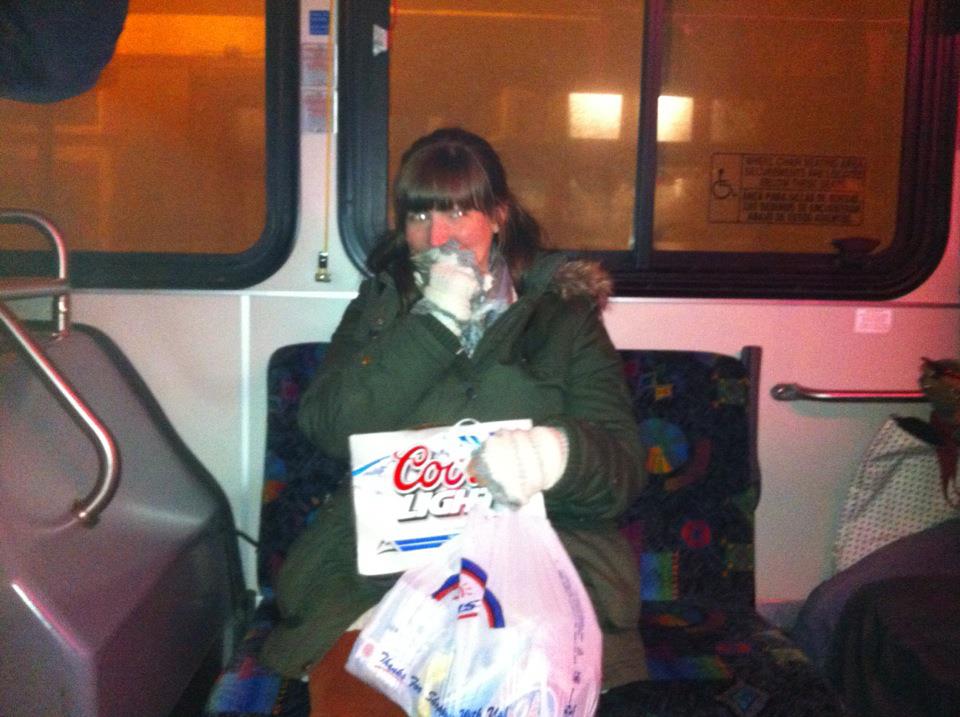
And had never used public transportation until the night we took this picture.

She participates in Women Swimmin', a fundraiser for Hospicare that involves swimming across Cayuga Lake.
I hope to join her this year.

She has a huge heart, as evidenced by her adopting this beautiful broken kitty.

She is fun to travel with.
Best quote ever: "I love Vermont! You wake up with no hangover and
the coffee comes out of the wall!"

And she is capable of great feats of strength.
Christen is going back to school to study nursing and I admire the heck out of her for juggling school, work, her pets, crazy friends, and everything else life can throw at you and making it all look easy. She is awesomesauce incarnate and I am lucky to call her my friend.

Wednesday, March 20, 2013

W is for...

W is for... Whittaker.


 Roger Whittaker.

Nemesis of my childhood, voice of my nightmares, demon of the dinner hour.

In case you aren't aware, Roger Whittaker was "a Kenyan singer-songwriter and musician. His music can be described as easy listening or perhaps best as ballads. He is best known for his baritone singing voice and trademark whistling ability." Yowsa. Whistling ability. Yeppers.

When I was little (and perhaps before he knew better) my dad insisted on having calm, relaxing music playing while we had dinner together. His definition of 'relaxing music' veered closer to 'elevator music' than, say, something spiritual, transcendent or even classical. Instead of Enya or Debussy, we had Roger Whittaker.

I never knew how my dad had discovered Roger Whittaker. It's very likely he just picked up the cassettes at a gas station checkout on impulse. For the most part, my dad had some pretty awesome taste in music. Growing up, the cool kids next door would come over to borrow my dad's Who albums. I grew up recognizing the R. Crumb artwork on Big Brother & the Holding Company's Cheap Thrills album as much as any of my children's books. But he had a dark side. In his record collection amidst the Derek & the Dominoes, New Riders of the Purple Sage, Paul Simon, Blue Oyster Cult, James Taylor, and Grateful Dead albums sat anomalies like the Sandpipers' Guantanamera and that creepy Orleans album featuring the whole hairy, shirtless band. So apparently my dad had a subversive, easy listening side which led us to Roger Whittaker.

Eww. Just.... ewww.
I will always associate Roger Whittaker with the taste of brussels sprouts- two things that were forced on me at dinnertime that I loathed with the very fiber of my being and am totally unable to reconcile with now as an adult.

Eww. Just.... ewww.
Yes, I've tried brussels sprouts since. Prepared in many different ways, skillfully seasoned and cooked. I still think they're gross little cabbages, and I still hate them. One of the benefits of being an adult is that I no longer have to eat brussels sprouts and I exercise this right vigilantly. I hated them so much that I used every weapon in my arsenal to avoid eating them. I would lodge one in my cheek, ask to go to the bathroom and spit it out in the trash. (I had a very round face and there was little you could do to make me more chipmunky.) I would slowly over the course of the meal slide one off my plate and onto the floor (even the dog wouldn't touch them). Using all the slight of hand I could muster, I would palm one into one of the tiny little drawers in the hutch in our dining room. (This tactic had poor end results for me, as my mother would have no idea until the offending vegetable alerted her to its decomposing presence with a stink that made you worry someone had died in the floorboards. Upon finding it, I would be instantly blamed.)

And along with the sulphurous, cabbagey taste of brussels sprouts was Roger's oily, creepy voice singing old folk songs and new songs that he sang so laboriously they sounded like they were hundreds of years old. I hated "Dirty Old Town" the most because it seemed to me the most depressing tune in the history of the world, and this coming from a kid who would burst into tears over "Somebody Come and Play" from Sesame Street.

I was not alone in my loathing; my siblings shared my repulsion for Roger and his crooning. Although united in our purpose to rid 50 Russell Street (as well as the world) of Roger Whittaker, we employed different strategies. My brother Kevin's method combined misdirection and denial. He would pop every cassette we owned in the stereo- except Roger Whittaker- and feign confusion at his mistake.

"Kevin, this isn't Roger Whittaker."
"What? Are you sure?"
"This is 'Hot Legs' by Rod Stewart. Find the Roger Whittaker tape."
Close enough, right?
*pause*
"This is not Roger Whittaker."
"Yes it is."
"No, it's not. It's 'Oye Como Va.' Come on, now, focus. You know what the Roger Whittaker tape looks like! Just find it and put it on so we can eat our damn dinner."
*Sigh*
"This is the Nitty Gritty Dirt Band, Kevin."
"Same thing, right?"

Katie employed a tactic that was later adopted by the military in dealing with drug kingpins and middle eastern warlords. She would enjoy the music so loudly that in effect, my father would be punished for playing it. She'd sing along with Roger at the top of her lungs, mangling the French words to "Mon Pays Bleu," braying the chorus of "River Lady" with all she had, building gusto and volume with each successive song. My dad would drop his head, shake it in mild disgust and mutter, "Jesus," under his breath until side one finally snapped off and left us in quiet.
"Do you want me to flip it over and play side two, Dad?"
"God, no. Just leave it."
Success.

My role in all this was to hide the cassettes so Kevin didn't even have to pretend he couldn't find them.  Inevitably, old Roger wound up in the same drawer with my orphaned brussels sprouts.

Eventually, the tapes were lost for good, to our great relief, and except for Christmas Eve dinner, my dad gave up on playing music while we were gathered around the table. Years later, my sister and I were poking through the bargain cds in a display at a grocery store and came across The Best of Roger Whitaker on cd. We exchanged one horrified look and hid it deep amidst the Celine Dion karaoke tracks and Michael Jackson compilations.

I thought Roger's music existed solely to torture me and my siblings, but apparently, he has a devoted fan base. They post reviews like this on Amazon:

Yeah, Roger took us to other thoughts, too, most of which were not utterable amongst decent folk.

No. You were wrong.

Thursday, February 14, 2013

V is for ...


V is for Valentines.

Any of you who have been reading this blog all along know that Valentine's Day is one of my favorite holidays, but not for the reasons you might think.

When I was ten years old, my family lost our house to a fire two days before Valentine's Day. I've written and posted extensively about it and I'm not going to repeat myself here. This past summer, I did a PSA for the Red Cross about how they helped us out after the fire. With my family, we relived the whole night and for the first time, really discussed everything that happened. I knew most of the story, obviously, but there were some details I wasn't aware of. The most important was the truth about what happened to my dog, Murphy.


I had always assumed he escaped out the fence that night in the chaos. He was hit by a truck and suffered serious injuries, including a crushed pelvis. Our vet felt he should be put down, but my dad said there was no way that after the trauma his kids had been through and along with losing not only their home but all their belongings could he also tell his kids that their dog was dead. So we put him on cage rest and supplements for months and eventually he was back to jumping six-foot high fences. He lived another 13 years after that.

Anyway, I'd always felt horribly guilty that I didn't remember to snap his leash on him and take him with me. I wondered about my state of mind- after going back and forth upstairs and down after my siblings, holding my panic at bay and trying not to think about what was happening, was I pushed to the cracking point and that's why I forgot to rescue my dog? My beloved dog, whose license number I had memorized in case it might help find him when he got away.

But last summer, as my family sat around our kitchen table with a bottle of champagne and went over what happened that night, I heard for the first time that our neighbors took Murphy when we left the house. He was with them. We didn't just abandon him to escape when the firefighters arrived. He apparently kept running away from them and trying to find us, which is when he was hit by the truck. I cannot tell you how relieved this made me feel. For so long I'd felt so guilty about not rescuing him as well.

I love Valentine's Day because getting the valentines my classmates had saved for me was one of the best things in my life. It made me feel normal again, and made me realize that the world would go on and things would be ok again.


So, I'm really bothered by the Valentine's Day haters who seem to dismiss this holiday as a sort of 'rub it in the face of single people' kind of day. It's not to me, and I don't think it should be about that. It should be a reminder to tell the people in your world that you love them- your parents, your kids, your siblings, your friends, etc. And I'm totally on board with Leslie Knope's idea for Galentine's Day- a day dedicated to celebrating your lady friends. Let's get on this, shall we?